Humidifier Running But Air Still Dry? 8 Reasons Why and How to Fix It
Your humidifier running but air still dry problem stems from one of eight common issues: undersized units, air leaks, dirty filters, mineral buildup, faulty humidistats, furnace system conflicts, or placement errors. Indoor humidity should stay between 30-50% relative humidity for comfort and health. This guide walks you through each cause with specific fixes you can start today.
How to Tell If Your Humidifier Isn't Working Properly
Grab a hygrometer and check your actual humidity levels before troubleshooting anything else. These devices cost under $15 and give you objective data instead of guesswork. If readings stay below 30% while your humidifier runs, something is wrong.
Your home tells you when humidity is too low:
- Static electricity: Shocks when touching doorknobs, staticky hair and clothes
- Physical symptoms: Dry, flaky skin, cracked cuticles, irritated nasal passages
- Home damage: Cracked wood furniture, gaps in floorboards, wooden instruments going out of tune
- Visible signs: Paint peeling at corners, wallpaper edges curling
Test your humidifier's output directly. Ultrasonic models produce visible mist you can see and feel. Evaporative models work through evaporation, so hold your hand over the output to feel moisture. No mist or moisture means the unit needs attention.
I spent two weeks adjusting settings before buying a $12 hygrometer. Turns out my humidity was sitting at 22%. That hygrometer paid for itself in one afternoon of targeted troubleshooting.
Wrong Humidifier Size for Your Room
A humidifier rated for 300 square feet will struggle in a 500-square-foot space, no matter how long it runs. Manufacturers rate capacity in gallons per day or square footage coverage. Match these ratings to your actual room dimensions.
| Room Size | Recommended Capacity | Tank Size | Runtime |
|---|---|---|---|
| Small (up to 300 sq ft) | 1-2 gallons/day | 1 gallon | 12-24 hours |
| Medium (300-500 sq ft) | 2-3 gallons/day | 1.5-2 gallons | 12-18 hours |
| Large (500-1000 sq ft) | 3-4 gallons/day | 2-3 gallons | 10-16 hours |
| Extra Large (1000+ sq ft) | 5+ gallons/day | 4+ gallons | 8-12 hours |
Open floor plans need special consideration. That 400-square-foot living room connected to your kitchen and hallway functions as 800+ square feet of airspace. Calculate total connected space, not individual rooms.
Ceiling height matters too. A room with 10-foot ceilings holds 25% more air than the same footprint with 8-foot ceilings. Multiply square footage by ceiling height, then divide by 8 to get your adjusted coverage needs.
Air Leakage Is Letting Dry Air In
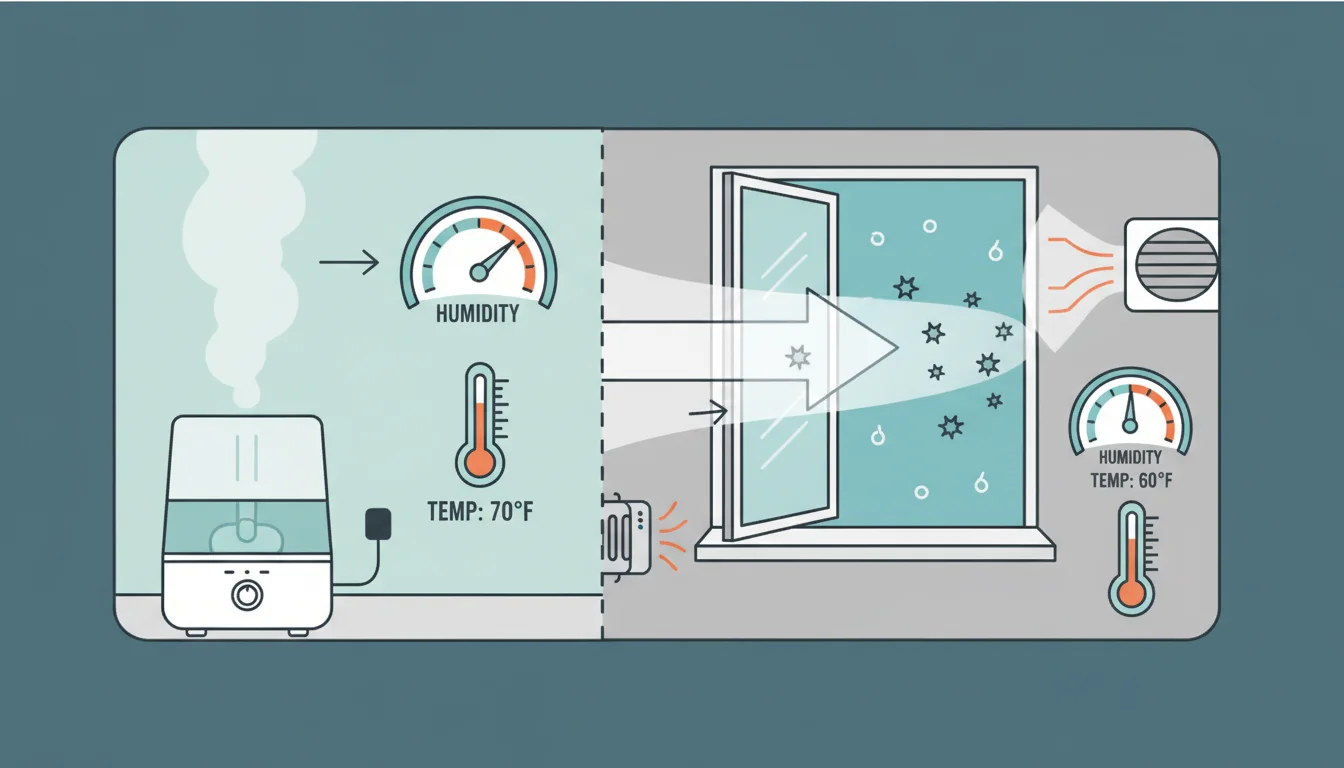
Cold winter air holds almost no moisture. Every gap in your home's envelope lets that bone-dry air inside, forcing your humidifier to work against a constant influx of dry air. Research from Oak Ridge National Laboratory confirms that leaky homes experience significant indoor humidity drops because outdoor air continuously replaces humidified indoor air.
Common leak points to check:
- Windows: Gaps around frames, failed weatherstripping, single-pane glass
- Doors: Bottom gaps, worn seals, mail slots
- Electrical outlets: Especially on exterior walls
- Attic access: Pull-down stairs, hatches without gaskets
- Plumbing penetrations: Where pipes enter from crawlspaces
Find leaks with a simple test. Light an incense stick and hold it near suspected areas on a windy day. Watch the smoke—horizontal movement indicates airflow and leaks.
Fixes are inexpensive:
- Weatherstripping: $5-15 per door or window
- Caulking: $3-8 per tube for cracks and gaps
- Door sweeps: $10-20 each
- Outlet insulators: $5 for a pack of 12
I sealed outlets on my north-facing wall and noticed my humidifier tank lasting 30% longer within a week. The [Oak Ridge National Laboratory] study showed tighter homes maintain more stable humidity with smaller fluctuations.
Humidifier Maintenance Issues
Neglected maintenance is the most common reason humidifiers underperform. Dirty filters restrict airflow by 50% or more, while mineral scale on wicks blocks water absorption. Both problems make your unit work harder while producing less moisture.
Cleaning schedule that works:
| Component | Frequency | Method |
|---|---|---|
| Water reservoir | Weekly | Empty, rinse, dry completely |
| Tank surfaces | Weekly | Wipe with diluted white vinegar |
| Filter/wick | Monthly inspection | Replace if discolored or stiff |
| Base unit | Monthly | Scrub mineral deposits with vinegar solution |
| Full deep clean | Monthly | Disassemble and clean all parts |
Replacement timeline:
- Portable humidifier filters: Every 6 weeks to 3 months
- Evaporative wicks: Every 1-3 months depending on water hardness
- Whole-house humidifier pads: Annually, or twice yearly with hard water
Switch to distilled water. Hard tap water leaves mineral deposits that clog wicks and create white dust on furniture. Distilled water costs about $1 per gallon and dramatically extends component life while reducing cleaning frequency.
[Kliemann Brothers] recommends a 1:3 vinegar-to-water solution for removing mineral buildup. Soak affected parts for 20-30 minutes, then scrub with a soft brush. This restored my evaporative humidifier's output after it had dropped to almost nothing.
Humidistat Settings and Calibration Problems
Built-in humidistats on most humidifiers are notoriously inaccurate, sometimes reading 10-15% higher or lower than actual humidity. Your unit thinks it has reached the target and shuts off while your room sits at 25% humidity.
Test accuracy by placing a separate hygrometer next to your humidifier for 24 hours. Compare readings. If your humidistat reads 45% while the hygrometer shows 30%, you have a calibration problem.
Recommended settings by season:
- Winter: 30-40% (lower prevents window condensation)
- Spring/Fall: 40-50%
- Summer: Let your AC handle dehumidification
Setting humidity too high in winter causes condensation on cold windows and walls. That moisture breeds mold and damages window frames. If you see fog on windows, reduce your target by 5%.
For unreliable built-in controls, ignore the humidistat entirely. Run the unit continuously and monitor with your separate hygrometer. Adjust runtime manually based on actual readings.
Furnace Humidifier vs Portable Unit Problems
Whole-house furnace humidifiers only add moisture when the furnace runs. During mild weather or in well-insulated homes where the furnace cycles infrequently, these systems barely operate. Your humidity drops between heating cycles.
Common furnace humidifier failures:
- Clogged water line: Mineral deposits block the small supply tube
- Faulty solenoid valve: The electronic valve fails to open
- Dried-out evaporator pad: Scale buildup prevents water absorption
- Incorrect damper position: Bypass humidifiers need the damper set for the season
Bypass vs fan-powered comparison:
| Feature | Bypass Humidifier | Fan-Powered Humidifier |
|---|---|---|
| Operation | Uses furnace blower | Has own fan motor |
| Output | 12-17 gallons/day | 18+ gallons/day |
| Works without heat | No | Yes (with fan) |
| Installation | Needs bypass duct | Direct mount |
| Energy use | Lower | Slightly higher |
Portable humidifiers work independently of your HVAC system. They run whenever you need them. For severe dry air problems, use both: a whole-house unit for baseline humidity and a portable unit in problem rooms like bedrooms.
Check your furnace humidifier's water supply. Turn off the water, disconnect the line, and blow through it. Resistance means mineral blockage. Replace the line for under $10.
Humidifier Placement Mistakes
Where you put a portable humidifier affects output more than most people realize. Corner placement against two walls traps moisture. Placing it on carpet lets the base absorb humidity before it reaches the air.
Optimal placement guidelines:
- Position at least 12 inches from walls
- Set on a hard, water-resistant surface elevated 2 feet off the floor
- Point output toward room center, not toward furniture or walls
- Keep away from heat sources that evaporate mist before distribution
- Place near return air vents for whole-house circulation
Avoid putting humidifiers near thermostats. The localized moisture tricks your HVAC system into thinking humidity is higher than actual room levels, causing premature shutoff.
Bedrooms need special attention. Place the humidifier 3-6 feet from your bed, pointed toward the center of the room. Too close creates discomfort; too far reduces effectiveness where you need it most.
I moved my bedroom humidifier from the floor to a nightstand and from the corner to mid-wall. Same unit, same settings. Humidity jumped from 32% to 41% overnight.
When to Call an HVAC Professional
Professional help makes sense after you have tried the obvious fixes without improvement. Technicians have access to diagnostic tools and system knowledge beyond DIY capabilities.
Signs you need a pro:
- Whole-house humidifier produces zero output despite water supply
- Humidity stays below 25% with multiple units running
- You notice mold around HVAC equipment
- Water leaks from furnace humidifier connections
- Unusual sounds from humidifier components
What technicians diagnose:
- Solenoid valve electrical failures
- Control board malfunctions
- Ductwork issues affecting moisture distribution
- HVAC system sizing problems
- Hidden air leakage pathways
Expect to pay $75-200 for a service call and diagnosis. Parts and repairs add to this depending on the problem. Ask for itemized quotes before authorizing work.
Questions to ask your technician:
- Is my humidifier sized correctly for my home?
- Are there ductwork modifications that would improve distribution?
- Should I consider upgrading to a fan-powered unit?
- What maintenance schedule do you recommend for my system?
A good technician explains the problem and your options without pushing expensive replacements. Get a second opinion if recommendations seem excessive.
FAQ
Why does my humidifier run all day but humidity stays low?
Your unit is undersized for the space, air leaks are bringing in dry outdoor air faster than humidification occurs, or mineral buildup has reduced output capacity. Check all three factors systematically.
How long should it take for a humidifier to raise humidity?
A properly sized unit in a sealed room raises humidity noticeably within 2-4 hours. Whole-house systems take 24-48 hours to affect entire homes. No change after 48 hours indicates a problem.
Does opening windows affect humidifier effectiveness?
Opening windows lets dry winter air rush in and humid air escape. Your humidifier fights a losing battle. Keep windows closed during humidification and ventilate briefly during milder parts of the day.
Can a humidifier be too big for a room?
Oversized humidifiers create excess moisture that condenses on windows, walls, and furniture. This promotes mold growth and damages building materials. Match capacity to room size and reduce settings if condensation appears.
Why does humidity drop at night when the furnace runs more?
Furnaces heat air but do not add moisture. Warmer air has lower relative humidity even with the same absolute moisture content. Whole-house humidifiers should compensate, but undersized units or maintenance issues prevent adequate moisture addition.
Should I run my humidifier with the fan on or auto?
Running your HVAC fan continuously distributes humidity more evenly throughout your home. Auto mode only circulates air during heating cycles, creating humidity pockets near the humidifier and dry zones elsewhere.
What humidity level prevents static electricity?
Static electricity diminishes significantly above 35% relative humidity and becomes negligible above 40%. If you still get shocks at 40% or higher, check hygrometer accuracy or look for localized dry spots in your home.
Is warm mist or cool mist better for dry air?
Both add equal moisture when sized correctly. Warm mist humidifiers use more energy but kill bacteria through boiling. Cool mist units are safer around children and cost less to operate. Effectiveness depends on capacity, not mist temperature.
Share this post
Related Posts
Who Should Not Use a Humidifier: 8 Groups at Risk in 2026
Who Should Not Use a Humidifier: 8 Groups at Risk in 2026
Will a Humidifier Help With Bloody Nose? Science-Backed Answer for 2026
Will a Humidifier Help With Bloody Nose? Science-Backed Answer for 2026
Best Humidifiers for Sinus Issues: Expert Guide to Relief in 2026
Best Humidifiers for Sinus Issues: Expert Guide to Relief in 2026