Humidifier Inside Grow Tent: Complete Placement & Setup Guide for 2026
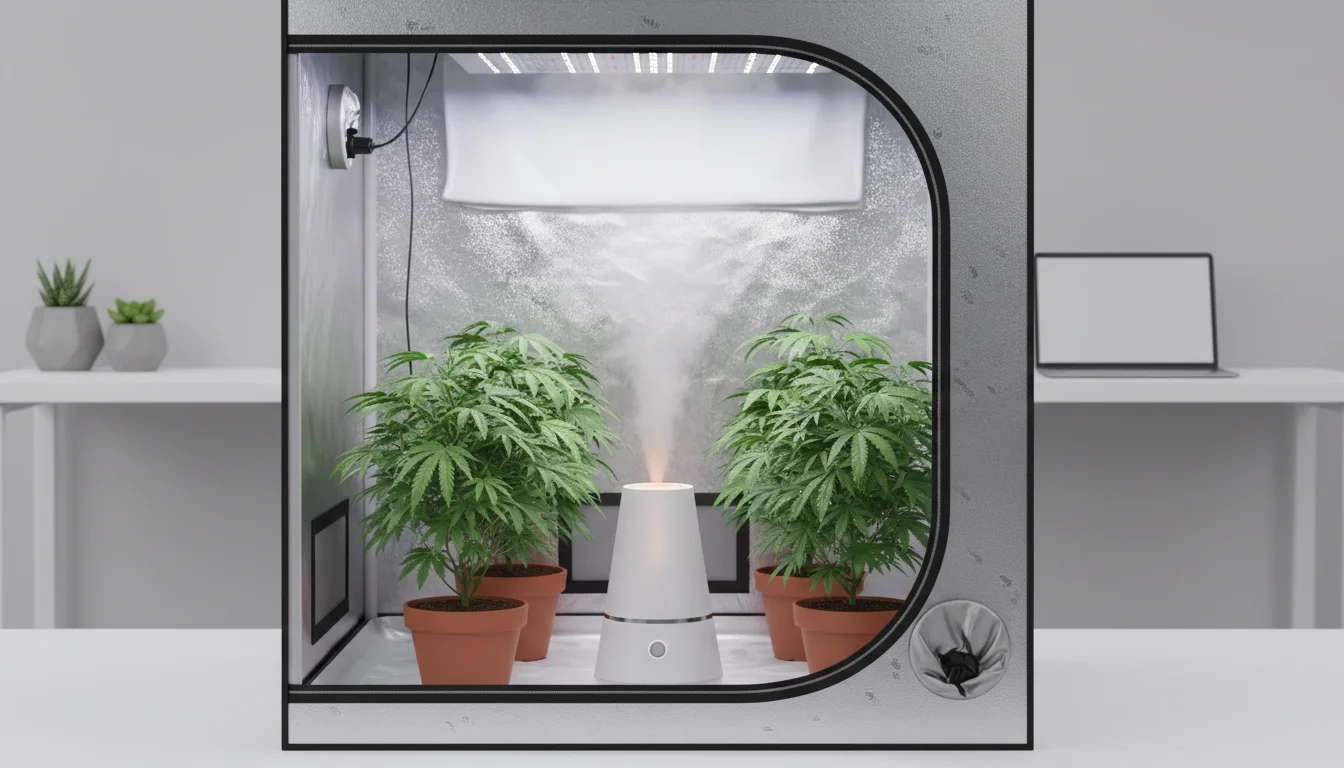
A humidifier inside grow tent setup adds moisture directly to enclosed growing environments where plants lose water through transpiration faster than ambient air can replenish it. Maintaining proper vapor pressure deficit (VPD) through humidity control increases yields by 15-30% compared to unmanaged environments. This guide covers optimal positioning strategies, humidity targets for each growth stage, and integration with your ventilation system.
Why Humidity Control Matters in Grow Tents
Enclosed grow tents create isolated microclimates where humidity fluctuates rapidly without active management. Your plants release water vapor through their leaves constantly. Without intervention, this moisture either builds up or gets stripped away by exhaust fans.
Here's what goes wrong at incorrect humidity levels:
- Low humidity (below 40%): Plants close their stomata to conserve water, shutting down photosynthesis and nutrient absorption
- High humidity (above 70% in flower): Fungal diseases thrive, bud rot destroys harvests, and root systems suffocate
- Fluctuating humidity: Stresses plants repeatedly, stunting growth and reducing final yield
- Poor VPD balance: Disrupts the pressure differential between leaf moisture and air moisture, slowing transpiration
The relatively small air volume inside grow tents makes humidity swing dramatically within hours. A 4x4 tent holds roughly 64 cubic feet of air, and your plants transpire constantly into that limited space.
I learned this the hard way during my first indoor grow. Humidity crashed to 25% every time my exhaust fan cycled on, and the plants showed calcium deficiency symptoms within a week. The problem wasn't nutrients—it was humidity preventing proper uptake. [AC Infinity] confirms that active humidity management through humidifiers provides the precise control these enclosed environments demand.
Optimal Humidity Levels by Plant Growth Stage
Different growth phases require dramatically different moisture levels in the air. Seedlings need high humidity because their root systems haven't developed enough to supply water demands. Flowering plants need dry conditions to prevent mold from destroying dense buds.
| Growth Stage | Optimal RH | Temperature Range | Why This Level |
|---|---|---|---|
| Seedling/Clone | 65-80% | 72-82°F | Undeveloped roots rely on leaf moisture absorption |
| Early Vegetative | 60-70% | 70-85°F | Supports rapid leaf expansion and stem growth |
| Late Vegetative | 55-65% | 70-85°F | Prepares plants for lower flowering humidity |
| Early Flowering | 45-55% | 68-80°F | Reduces mold risk as buds begin forming |
| Late Flowering | 40-50% | 65-78°F | Prevents bud rot in dense flower clusters |
| Final Week/Harvest | 30-40% | 65-75°F | Begins drying process for optimal cure |
Drop humidity by roughly 5% each week during the transition from vegetative to flowering growth. This gradual reduction prevents shock while conditioning plants for the drier conditions ahead.
GrowerIQ research shows that humidity above 60% during flowering dramatically increases botrytis (bud rot) infection rates. Trust me—finding gray mold inside your best cola during harvest week ruins everything.
Inside vs Outside Tent Placement: Pros and Cons
Placing your humidifier inside the tent delivers faster humidity response but consumes growing space. External placement with ducting preserves floor area but requires more setup work.
| Factor | Inside Placement | Outside Placement (Ducted) |
|---|---|---|
| Response Time | Fast, direct control | Slower, depends on duct length |
| Space Usage | Takes floor/shelf space | Zero tent footprint |
| Water Damage Risk | Higher, spills affect plants | Lower, contained outside |
| Setup Complexity | Simple, plug and place | Requires ducting and sealing |
| Best For | Tents under 4x4 feet | Larger operations, ultrasonic units |
| Maintenance Access | Must open tent | Service without disturbing plants |
Inside placement works best when you need precise, rapid humidity adjustments. The humidifier sits in the same air volume as your plants, responding immediately to changes.
Outside placement makes sense for ultrasonic humidifiers that produce visible mist. That mist settles on nearby surfaces, so keeping the unit outside prevents water spots on leaves and equipment. [Gorilla Grow Tent] recommends external placement with 4-inch ducting for operations running multiple tents from a single larger humidifier.
Best Positions for Humidifier Inside Your Grow Tent
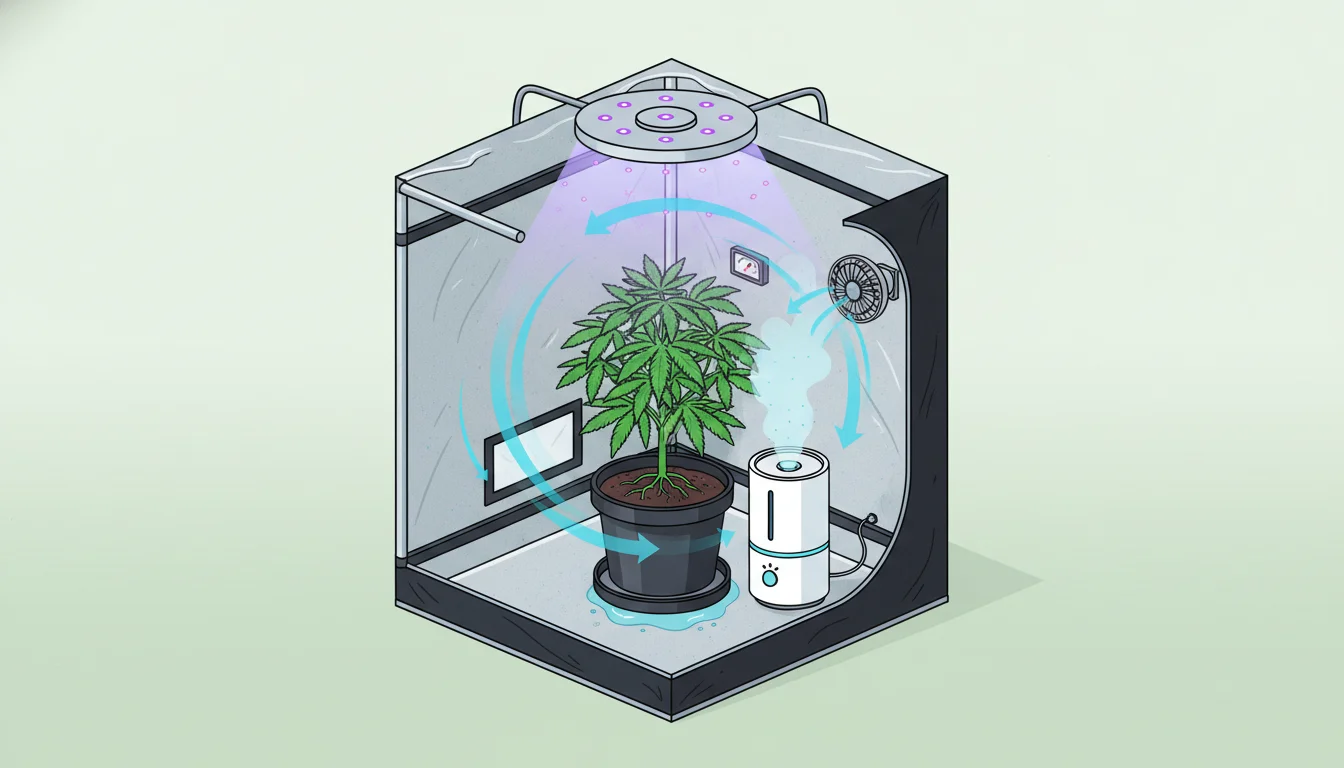
Position your humidifier near the passive air intake, elevated on a platform, at least 2 feet from the nearest plant. This placement allows circulation fans to distribute moisture evenly before it contacts foliage directly.
For 2x2 tents:
- Corner placement with mist outlet facing upward
- Elevate 6-12 inches off the floor on a small shelf
- A single oscillating fan helps distribute moisture
For 4x4 tents:
- Center-back position near the intake vent
- Platform height of 12-18 inches works best
- Keep 2-3 feet minimum distance from the plant canopy
For 5x5 and larger:
- Consider two smaller units on opposite corners
- External placement with ducted input becomes practical
- Multiple circulation fans prevent dead zones
Avoid these positioning mistakes:
- Directly under grow lights: Heat causes rapid evaporation, wasting water and reducing effectiveness
- Touching tent walls: Condensation forms and drips, creating wet spots
- At plant height: Direct mist contact promotes leaf fungus
- Near exhaust fan: Humid air gets pulled out immediately
A word of caution about placement near intakes: if your intake draws air from a humid basement, you'll fight excess moisture instead of deficiency. Measure your ambient humidity first. [Miro Home] emphasizes that intake positioning only works when ambient air is drier than your target humidity.
Types of Humidifiers for Grow Tents
Ultrasonic cool mist humidifiers dominate grow tent applications because they operate silently and add no heat to enclosed spaces. Other types serve specific situations.
| Type | Pros | Cons | Best For |
|---|---|---|---|
| Ultrasonic | Quiet, cool mist, energy-efficient, precise output | White mineral dust with tap water, requires distilled water | Most grow tent applications |
| Evaporative | Self-regulating, no mineral residue, natural humidity limit | Requires filter replacement, louder operation | Hard water areas, hands-off growing |
| Warm Mist | Kills bacteria in water, no filters needed | Adds heat, burn risk, high energy use | Not recommended for grow tents |
| Impeller | Affordable, cool mist, simple design | Loud, coarse mist, splashing | Budget setups, temporary use |
Look for these features when shopping:
- Built-in hygrostat: Automatically maintains target humidity without external controllers
- Tank capacity over 1 gallon: Reduces refill frequency during demanding growth stages
- Top-fill design: Makes refilling easier without removing the unit
- Adjustable mist direction: Aims output toward circulation airflow
Compact models with 1-2 gallon tanks handle most tents up to 4x4 feet. Larger spaces need 4+ gallon reservoirs or multiple smaller units. I run two small humidifiers in my 5x5 instead of one large unit—redundancy means one failure doesn't crash my humidity overnight.
Integration with Ventilation and Exhaust Systems
Your exhaust fan removes humidity faster than most growers realize. A 200 CFM fan exchanges your entire tent's air volume every 20 seconds in a 4x4 tent. Every air exchange pulls humid air out and draws dry air in.
Balance humidifier output with exhaust rates:
- Reduce fan speed during lights-off: Plants transpire less, so humidity stays stable longer
- Use fan speed controllers: Adjust extraction based on temperature and humidity readings
- Position humidifier in the airflow path: Circulation fans carry moisture throughout the canopy before exhaust removes it
- Seal light leaks and gaps: Air leaks let humidity escape uncontrolled
Smart controller integration transforms humidity management:
- Inkbird or similar controllers: Trigger humidifier on/off based on hygrometer readings
- AC Infinity controller systems: Manage fans and humidifiers from one interface
- Separate day/night programs: Account for different humidity dynamics during each period
Seasonal changes affect your baseline dramatically. Summer ambient humidity in many regions exceeds 60%, while winter heating drops indoor humidity below 30%. Adjust your humidifier output monthly as seasons shift. [420 Magazine] forum members report needing 2-3x more humidifier output in winter months compared to summer.
Common Mistakes and Troubleshooting Tips
Most humidity problems trace back to placement errors or ignoring the relationship between humidifier output and exhaust rates.
Mistake: Humidifier too close to plants Water droplets land directly on leaves, and fungal spores germinate in standing moisture. Move the unit back and aim mist toward circulation fans instead.
Mistake: Using tap water Minerals in tap water create white dust that coats leaves and equipment. Ultrasonic units atomize everything in the water, including calcium and magnesium deposits. Use distilled or RO water exclusively.
Mistake: Ignoring exhaust fan impact Your humidifier adds 300ml per hour while your exhaust fan removes the entire air volume 180 times per hour. The math doesn't work. Reduce fan speed or increase humidifier capacity.
Troubleshooting low humidity despite running humidifier:
- Check for unsealed vent holes and light leaks
- Measure exhaust CFM and calculate air exchanges per hour
- Verify the humidifier is producing mist (mineral buildup blocks output)
- Consider ambient humidity in your lung room
Troubleshooting condensation on tent walls:
- Reduce humidifier output setting
- Increase air circulation with additional fans
- Check that exhaust is actually running
- Raise temperature slightly to increase air moisture capacity
Weekly maintenance prevents problems:
- Empty and rinse reservoir every 3-4 days
- Wipe ultrasonic disc with white vinegar weekly
- Replace evaporative filters monthly during heavy use
- Inspect for pink or black mold growth in tank
Cleaning the humidifier feels tedious when you're busy with plant care, but bacteria colonies in stagnant reservoir water get aerosolized directly onto your plants. That's asking for trouble.
FAQ
How often should I refill my grow tent humidifier?
Refill frequency depends on tank size, output setting, and growth stage demands. A 1-gallon humidifier running at medium output in a 4x4 tent during vegetative growth needs daily refilling. Larger 4-gallon units stretch to 3-4 days between fills.
Do I need a humidifier for flowering stage?
Most flowering environments need dehumidification rather than humidification. Target 40-50% RH during flower to prevent bud rot. You'll likely run your exhaust fan harder and potentially add a dehumidifier instead during this stage.
What size humidifier do I need for a 4x4 grow tent?
A humidifier rated for 300-500 square feet with at least a 1.5-gallon tank capacity handles 4x4 tents effectively. Look for output ratings of 200-400ml per hour for adequate moisture addition against typical exhaust fan removal rates.
Should I run my humidifier 24/7?
Continuous operation wastes water and electricity while potentially creating excess humidity during lights-off periods when transpiration slows. Use a hygrostat-controlled unit or external humidity controller to cycle the humidifier on demand.
Why is my grow tent humidity still low with humidifier running?
Your exhaust fan removes humidity faster than the humidifier adds it. Reduce fan speed, seal air leaks, verify the humidifier is producing mist, and check that you haven't clogged the ultrasonic disc with mineral deposits.
Is distilled water necessary for grow tent humidifiers?
Distilled or reverse osmosis water prevents mineral dust from coating your plants and equipment. Tap water works in evaporative humidifiers since the filter traps minerals. Ultrasonic units require mineral-free water for clean operation.
Where should I place the hygrometer in my grow tent?
Position your hygrometer at plant canopy height, away from direct humidifier mist and not directly in the exhaust airflow path. This location measures the humidity your plants actually experience rather than artificially high or low readings.
Share this post
Related Posts
Who Should Not Use a Humidifier: 8 Groups at Risk in 2026
Who Should Not Use a Humidifier: 8 Groups at Risk in 2026
Will a Humidifier Help With Bloody Nose? Science-Backed Answer for 2026
Will a Humidifier Help With Bloody Nose? Science-Backed Answer for 2026
Best Humidifiers for Sinus Issues: Expert Guide to Relief in 2026
Best Humidifiers for Sinus Issues: Expert Guide to Relief in 2026