Humidifier Without White Dust: Complete Guide to Dust-Free Humidity in 2026
White dust is mineral residue from tap water that ultrasonic humidifiers disperse into the air, leaving calcium and magnesium deposits on furniture, electronics, and floors. Tests show that switching to distilled water or evaporative technology eliminates this problem entirely. This guide explains why white dust forms and how to choose a humidifier without white dust for your home.
What Causes White Dust in Humidifiers?
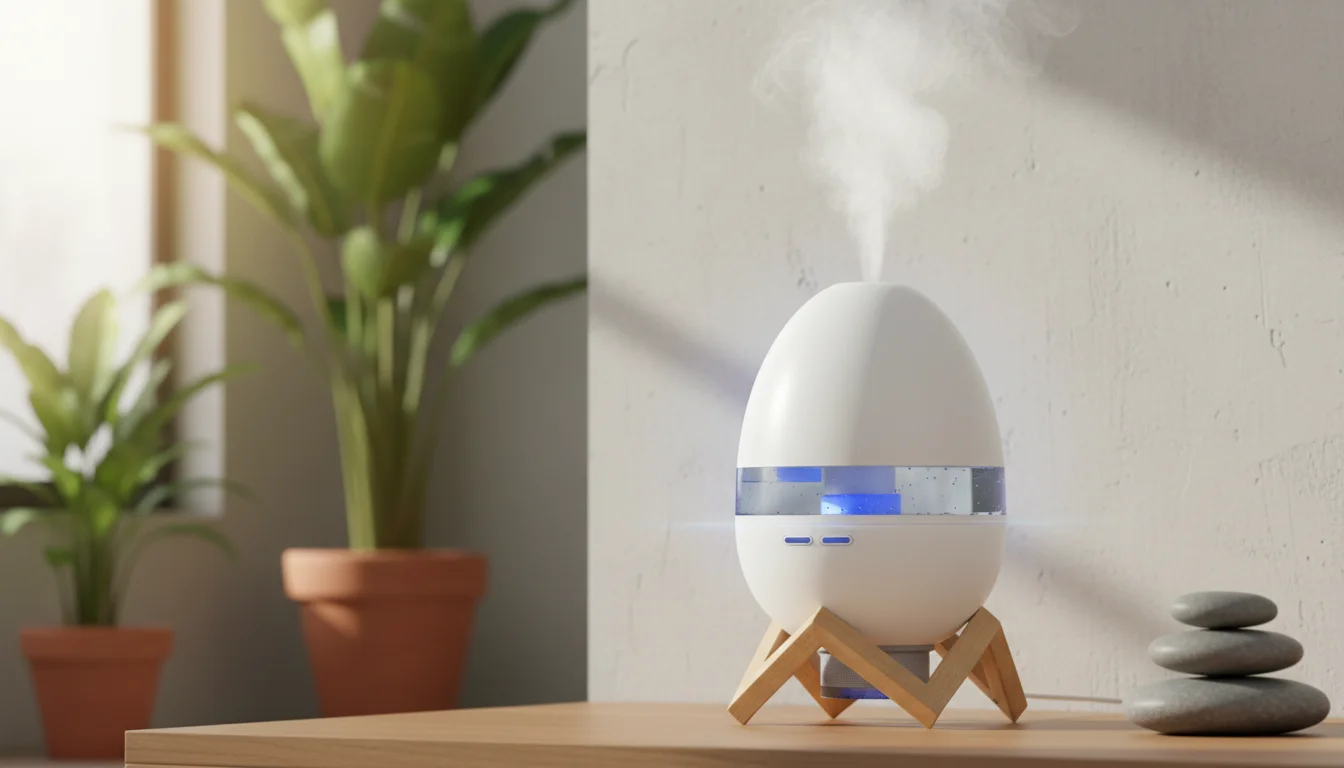
Dissolved minerals in your tap water become airborne particles when ultrasonic humidifiers atomize water into fine mist.
Hard water contains high concentrations of calcium and magnesium. When an ultrasonic humidifier vibrates water at high frequency, it breaks the liquid into tiny droplets that carry dissolved minerals directly into your air.
The water evaporates. The minerals don't. They float through your room and settle as fine white powder on every surface.
- Tap water mineral content: Average tap water contains 100-400 ppm of dissolved minerals, with hard water areas exceeding 180 ppm
- Ultrasonic atomization: High-frequency vibrations create 1-5 micron water droplets that carry minerals into the air
- Surface accumulation: Mineral particles settle on furniture, electronics, dark surfaces, and floors within hours
- Health pathway: Airborne mineral particles remain suspended and get inhaled before settling
If you live in a hard water area, you'll notice white dust within days of running an ultrasonic unit. I measured visible residue on a black TV stand after just 48 hours using Phoenix tap water. The buildup compounds quickly.
According to RTINGS, ultrasonic humidifiers using tap water produce significant white dust, while the same units using distilled water produce negligible amounts.
Types of Humidifiers That Don't Produce White Dust
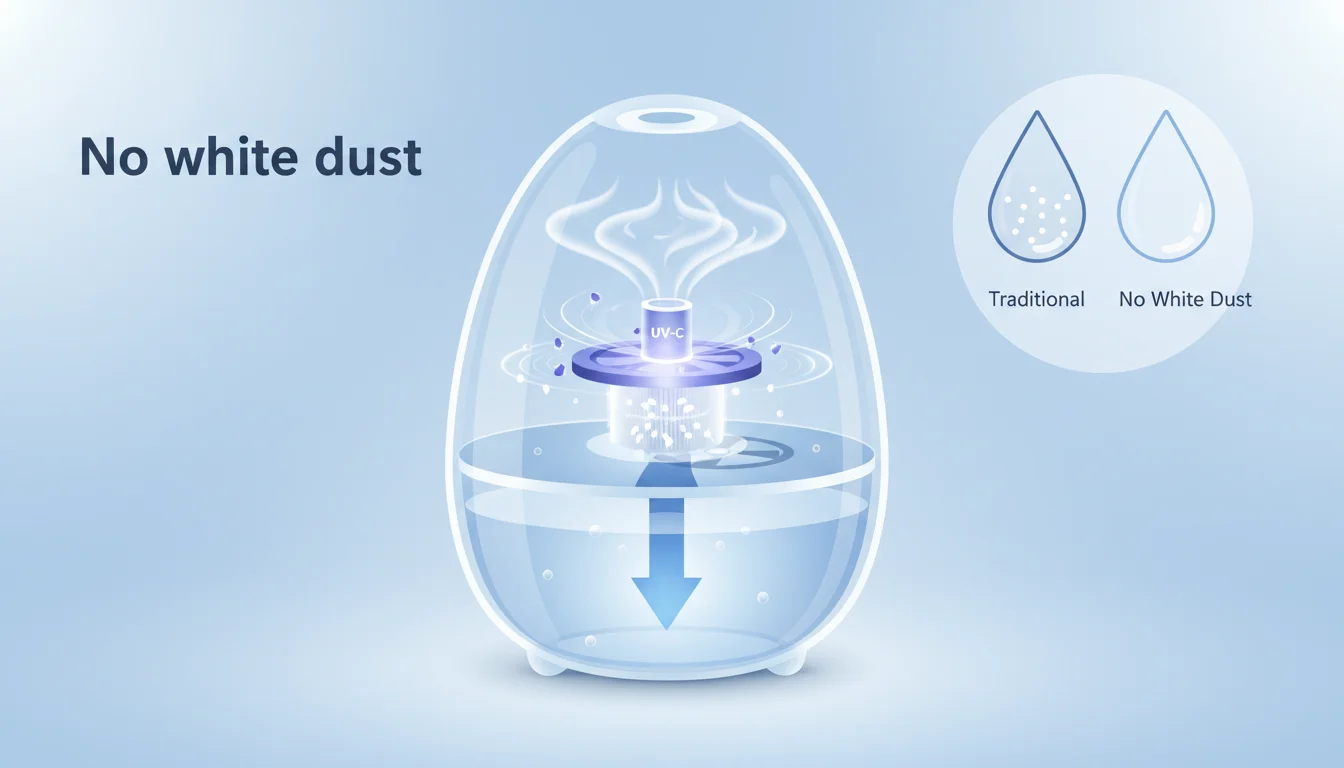
Evaporative, warm mist, and steam vaporizer humidifiers prevent mineral dispersion through fundamentally different water delivery methods.
| Humidifier Type | How It Prevents White Dust | Noise Level | Energy Use | Safety Concern |
|---|---|---|---|---|
| Evaporative | Wick filter traps minerals before water evaporates | Moderate to loud (fan-driven) | Low | None |
| Warm Mist | Boils water; minerals stay in tank | Quiet | High | Hot water reservoir |
| Steam Vaporizer | Heats water to steam; minerals left behind | Quiet | High | Very hot steam output |
Evaporative humidifiers draw air through a wet wick filter using a fan. Water evaporates naturally, but minerals stay trapped in the filter material. You replace filters periodically, but white dust never enters your air.
Warm mist humidifiers heat water to boiling before releasing steam. Since minerals don't evaporate with water vapor, they remain in the tank as scale buildup. The boiling process also kills bacteria.
Steam vaporizers work similarly to warm mist units but produce hotter output. Both require more electricity than cool mist options.
For bedrooms, the fan noise of evaporative units bothers some users. Warm mist models run quieter but cost more to operate. According to AiDot, evaporative humidifiers are better for health-conscious users because they produce no white dust and filter impurities effectively.
Evaporative vs Ultrasonic: Which Is Better for Dust-Free Operation?
Evaporative humidifiers eliminate white dust through mechanical filtration, while ultrasonic units require distilled water to achieve the same result.
| Factor | Evaporative | Ultrasonic |
|---|---|---|
| White dust with tap water | None | Significant |
| White dust with distilled water | None | Minimal |
| Upfront cost | $40-$150 | $25-$80 |
| Ongoing costs | Filter replacements ($15-$30 every 1-3 months) | Distilled water ($1-$2/gallon) or nothing |
| Noise level | 35-50 dB (audible fan) | 25-35 dB (near silent) |
| Room coverage | Large rooms (wick limits output in low humidity) | Small to medium rooms |
| Self-regulating | Yes (slows in high humidity) | No (runs at set output) |
The wick filter in evaporative models acts as a natural mineral barrier. Water passes through; minerals stay behind. This happens automatically with any water type.
Ultrasonic technology disperses whatever's in the water. Tap water means mineral dust. Distilled water means clean mist.
If avoiding white dust is your priority, evaporative technology wins. You'll pay more for filter replacements, but you'll never worry about water quality. Fair warning: the fan noise takes adjustment if you're used to whisper-quiet ultrasonic units.
How to Prevent White Dust with Any Humidifier
Using distilled or demineralized water eliminates mineral content before it reaches your humidifier's misting mechanism.
- Distilled water: Removes 99.9% of minerals through evaporation and condensation. Costs $1-$2 per gallon at grocery stores.
- Demineralization cartridges: Fit inside compatible humidifiers to capture minerals. Replace every 30-60 days depending on water hardness.
- Reverse osmosis water: Home RO systems produce low-mineral water at $0.02-$0.05 per gallon after an initial $200-$600 investment.
- Weekly tank cleaning: Prevents mineral scale buildup that reduces humidifier efficiency and harbors bacteria.
- Monthly deep cleaning: Use white vinegar to dissolve mineral deposits, then disinfect with 3% hydrogen peroxide.
The math on water options depends on usage. Running a humidifier 12 hours daily uses roughly 2-4 gallons. At $1.50 per gallon for distilled water, that's $90-$180 monthly.
An RO system pays for itself within 6-12 months of heavy use. I installed one after calculating my distilled water spending.
Hisoair emphasizes emptying and refilling water daily, never letting water sit for extended periods.
Health Impacts of White Dust Exposure
Inhaled mineral particles irritate respiratory systems, with greater effects on people who have asthma, allergies, or compromised lung function.
- Respiratory irritation: Fine mineral particles (under 10 microns) penetrate deep into lungs and cause inflammation
- Asthma triggers: Airborne particulates worsen symptoms in sensitive individuals
- Child vulnerability: Developing respiratory systems absorb more particles per body weight
- Pet concerns: Small animals with fast respiratory rates face higher exposure risks
The minerals themselves are non-toxic. Calcium and magnesium won't poison you. However, any fine particulate matter stresses your respiratory system when inhaled repeatedly.
For nurseries and bedrooms where you spend 8+ hours daily, dust-free humidification matters most. The cumulative exposure adds up. HVAC.com notes that while white dust is generally harmless, eliminating it reduces unnecessary particulate exposure in your breathing space.
Top Dust-Free Humidifier Features to Look For
Effective dust-free humidifiers combine mineral-blocking technology with practical features for daily use.
- Evaporative wick system: Quality wicking material (not cheap foam) traps minerals effectively and lasts longer between replacements
- Demineralization cartridge slot: Essential for ultrasonic models if you prefer quiet operation but want dust reduction
- Tank capacity: 1-gallon tanks need daily refills; 4+ gallon tanks run 24-48 hours continuously
- Noise rating under 40 dB: Bedroom-appropriate. Above 45 dB sounds like a running fan.
- Top-fill design: Bottom-fill tanks require lifting and flipping heavy water-filled reservoirs
- Dishwasher-safe components: Removable parts that survive dishwasher cycles simplify weekly cleaning
- Humidity sensor: Auto-adjusts output to maintain target humidity, preventing over-humidification
- Auto-shutoff: Stops operation when the tank empties, preventing motor damage
Look for humidifiers with wide tank openings. Narrow necks make scrubbing mineral deposits nearly impossible. Trust me—you'll clean this thing weekly.
[The Good Trade] highlights models like Blueair's InvisibleMist technology that combines effective humidification with antimicrobial filters and no dust dispersion.
FAQ
Do all ultrasonic humidifiers produce white dust?
Yes, all ultrasonic humidifiers produce white dust when using tap water or hard water. The atomization process disperses dissolved minerals regardless of brand or price point. Using distilled water prevents this entirely.
How often should I replace evaporative humidifier filters?
Replace wick filters every 1-3 months depending on water hardness and usage frequency. Hard water areas require more frequent changes. Discolored or stiff filters indicate mineral saturation and reduced effectiveness.
Is white dust from humidifiers harmful to electronics?
White dust settles on electronics and coats internal components over time. While not immediately damaging, mineral buildup on cooling fans, vents, and circuit boards reduces performance and lifespan. Dust-free operation protects your devices.
Does boiling tap water remove minerals for humidifier use?
No. Boiling kills bacteria but concentrates minerals by evaporating pure water. Boiled tap water actually produces more white dust than regular tap water. Only distillation or reverse osmosis removes dissolved minerals.
Are demineralization cartridges worth the cost?
Demineralization cartridges reduce white dust by 50-80% but don't eliminate it completely. At $15-$30 per cartridge every 1-2 months, they cost about the same as buying distilled water. They're a compromise solution, not a complete fix.
What humidity level prevents white dust buildup?
Humidity level doesn't affect white dust production. Mineral content in water determines dust output. Maintaining 40-50% humidity prevents excess moisture issues but won't reduce white dust. Water quality is the only factor that matters.
Do whole-house humidifiers produce white dust?
Whole-house humidifiers attached to HVAC systems use evaporative technology. Water flows over a pad, evaporates, and minerals stay behind. They don't produce white dust but require annual pad replacement and occasional descaling.
Share this post
Related Posts
Who Should Not Use a Humidifier: 8 Groups at Risk in 2026
Who Should Not Use a Humidifier: 8 Groups at Risk in 2026
Will a Humidifier Help With Bloody Nose? Science-Backed Answer for 2026
Will a Humidifier Help With Bloody Nose? Science-Backed Answer for 2026
Best Humidifiers for Sinus Issues: Expert Guide to Relief in 2026
Best Humidifiers for Sinus Issues: Expert Guide to Relief in 2026